
Discovering Motorcycling in Ireland
The Story of John Paul Burney and Ireland’s First Motorcycle Race on the 19th July 1904
On 19th July 1904, a small group of pioneering motorcyclists gathered quietly in Belfast for an event that would become a landmark in Irish motorcycling. Officially described as a “reliability trial”, it was in reality a race: 200 miles of primitive roads from Belfast to Derry and back towards Belfast, fought out on fragile early motorcycles. The winner, Belfast cyclist and Royal Enfield representative John Paul Burney, completed the course on a 3½ hp belt-driven machine and finished about 45 minutes ahead of his nearest rival.
There is something almost unbelievable about the story of Ireland’s first motorcycle road race. Today, a 200-mile motorcycle race would involve closed roads, medical crews, marshals, timing systems, sophisticated racing machines and extensive safety arrangements. In July 1904, the riders had none of these things.
They had primitive motorcycles, poor roads, very limited mechanical reliability and, in some cases, little more than their own ingenuity to get them to the finish.
And there was another problem: the organisers could not openly advertise what they were actually doing.
The event was officially presented as a reliability trial. The riders, however, knew that the first man to complete the course would be the winner. More than a century later, the event is widely described as Ireland’s first motorcycle road race and, by some sources, as the world’s first motorcycle road race. The latter claim should be treated with some caution because the history of very early motor-cycle competitions is complicated, but the significance of the Belfast–Derry event is not in doubt.
The occasion for the race
The event was organised by the Ulster Centre of the Motorcycle Union of Ireland on Tuesday, 19 July 1904.
Contemporary and later accounts say that the event was organised to mark the marriage of the Honourable Leopold Canning, who was president of the Ulster Centre. The organisers wanted to create a substantial motorcycle event, but a 200-mile competition on public roads presented an obvious problem.
Motorcycle racing was still in its infancy. There were no modern systems for closing public roads, and an openly advertised road race could have attracted unwanted attention from the authorities.
The solution was ingenious. The event was described as a “reliability trial” rather than a race. According to later accounts, secrecy was maintained so effectively that even well-informed members of the press did not know what was about to happen. The riders themselves, however, understood the real objective: complete the course before everybody else.
This distinction is important when describing the event today. It was not a modern road race in the regulatory sense. Nevertheless, it had the fundamental competitive characteristic of a race: riders competing to be the first to finish.
The start in Belfast
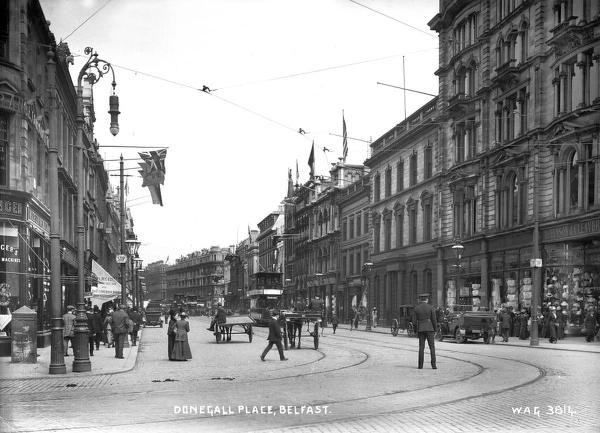
The competitors assembled at approximately 6am on the morning of 19 July at the Belfast Banking Company’s premises on Donegall Street, in the area of Belfast’s Stock Exchange.
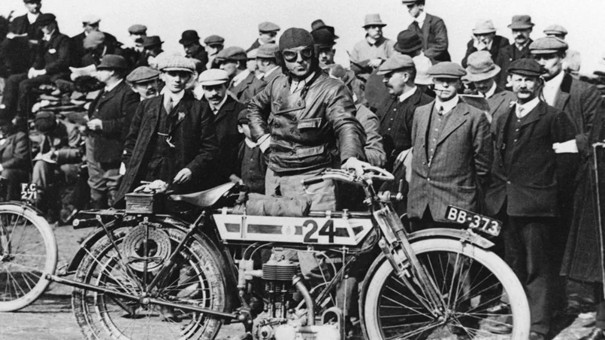
Imagine the scene. There were no racing paddocks, motorhomes or factory-backed teams. The motorcycles were essentially bicycles fitted with small petrol engines, and many looked remarkably primitive by modern standards.
The field contained machines from several manufacturers, including Royal Enfield, Excelsior, Minerva, Raleigh, F.N., Humber Centaur, Riley, Rex, Bat and Ormonde. Surviving accounts disagree about the exact number of starters and entries. One later account refers to approximately 30 competitors, while another reconstruction identifies 17 entries and says 15 riders actually assembled at the start.
That uncertainty is characteristic of the event’s history and is worth preserving rather than attempting to give a false impression of precision.
What is clear is that a substantial group of early motorcyclists gathered in Belfast that morning and set off together.
The 200-mile course
The route was extraordinarily ambitious for 1904. The riders travelled from Belfast northwards towards: Carrickfergus → Cushendall → Ballycastle → Portrush → Coleraine → Derry/Londonderry. They then turned back south and eastwards through the interior, travelling via Maghera and Toome, before finishing near Glengormley.
The modern description of the route is approximately 200 miles, although the exact mileage naturally depended upon the roads used at the time.
Much of the route bears a resemblance to today’s Causeway Coastal Route, but the road experience in 1904 was radically different.
There was little or no tarmac as we would understand it. Roads were rough, dusty and uneven, and the motorcycles had rigid forks, primitive suspension and basic tyres.
The consequences were immediate. Accounts recall that by the time the riders reached the Carrickfergus area, motorcycles were losing tool bags, pumps, spare parts and silencers because of the vibration and punishment inflicted by the road surface.
For a modern rider accustomed to a sophisticated adventure motorcycle with electronic suspension and traction control, it is difficult to imagine what riding 200 miles over those roads on a 1904 motorcycle must have been like.
The motorcycles
The winning machine was a 3½ horsepower Royal Enfield.
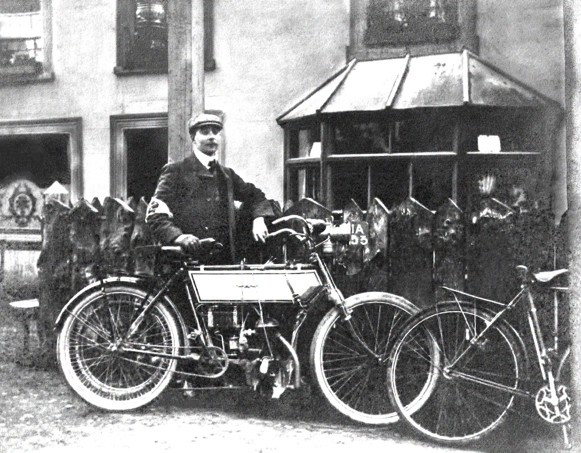
It was not remotely comparable with a modern Royal Enfield Himalayan or Continental GT. The engine was mounted in the bicycle-style frame and power was transmitted to the rear wheel through a belt.
The machine had:
- A single-cylinder engine
- Approximately 350cc displacement
- Belt drive
- Rigid forks
- A bicycle-style saddle
- A single-speed transmission
- Pedalling equipment
- Very basic braking and control systems
Royal Enfield itself records the 1904 victory as an important milestone in its history, describing Burney’s machine as a 350cc belt-driven motorcycle and stating that he finished approximately 45 minutes ahead of the second rider.
John Paul Burney – the man behind the victory
John Paul Burney was not an unknown amateur who happened to get lucky.
Born in 1875 in Hightown near Belfast, Burney had already established himself as a successful competitive cyclist. He had won important cycle races, including the Irish 100-mile championship on two occasions.
In 1902, he joined the Enfield Cycle Company as its Irish representative.
This was an important stage in his career. His cycling background gave him exceptional physical fitness and road-riding experience, while his work with Enfield gave him a close understanding of the emerging motorcycle industry. The combination proved ideal for the new age of motorcycling. Burney was therefore both a competitor and an industry professional. He understood endurance riding and knew how to get the best from an early motorcycle.
Burney nearly didn’t start
Perhaps the most remarkable detail of the story occurred before the race had even begun.
On the Saturday before the event, Burney broke the crank bracket axle on his Royal Enfield. The damage meant he had lost his pedalling gear, and the pedals also served as footrests.
It appeared that his participation was over.
Fortunately, Burney encountered fellow competitor Bob Ireton, who was working on his own motorcycle. The two men repaired Burney’s machine together. The repair was good enough to allow him to start. And, remarkably, Burney ultimately did not need the pedalling mechanism during the race.
It is a wonderful illustration of the pioneering character of early motorcycling: competitor and competitor helping each other repair their machines before competing against one another.
The race begins
Once underway, the more powerful or faster motorcycles initially appeared to have the advantage.
Alexander Parker, riding a Continental Minerva, took an early lead. His motorcycle had a reputation for speed and had been used for track racing and pacing on cycle tracks. But speed was only one part of the challenge. The roads were so rough that mechanical reliability became the dominant factor. Parker’s challenge ended when his petrol tank split and he lost his fuel. Petrol stations were obviously non-existent in the modern sense, and finding additional fuel on a remote section of the route was far from straightforward.
Oher riders encountered similar problems. One rider retired with a broken steering component. A.W. Hamilton, riding a four-cylinder F.N., left the road near Coleraine and went over a fence. Other motorcycles suffered punctures, ignition problems and mechanical failures. The reliability trial was proving to be exactly what its official title suggested.
Burney’s strategy
Burney took a different approach. Rather than attempting to lead from the start, he maintained a steady pace and allowed apparently faster riders to go ahead. It was an inspired strategy. As the race progressed, the faster machines began to encounter problems. Burney’s Royal Enfield, meanwhile, continued to run reliably.
According to accounts based on Burney’s recollections, he began to increase his pace from around Ballycastle onwards. By the time he reached Derry, he had established a substantial lead. One account puts his advantage at approximately 20 minutes at Derry; other sources record that he ultimately finished around 45 minutes ahead of the second-place rider.
The lesson was already one that would become fundamental to motorcycle endurance competition: Finishing fast is irrelevant if the motorcycle doesn’t finish.
The final run to Glengormley
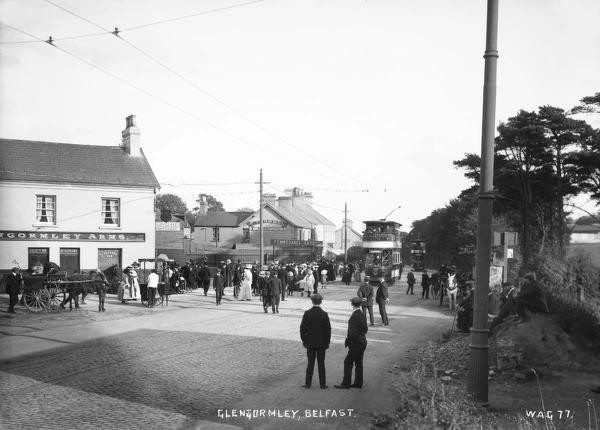
After reaching Derry, the riders began the return journey. The route took them inland through Maghera and Toome before heading towards the finish at the Crown and Shamrock Inn in Glengormley.
The finish was a far cry from the grandstands and timing gantries of modern motorcycle racing. There was no huge crowd. No television coverage. No photographers positioned around the circuit. Yet when Burney arrived, he had achieved something extraordinary. He had ridden approximately 200 miles on a 3½ hp motorcycle over primitive Irish roads and had beaten the remaining opposition by a substantial margin.
The result
The precise finishing order is one of the areas where historical sources differ. The most consistently reported result is:
Position | Rider | Motorcycle |
1st | J.P. Burney | 3½ hp Royal Enfield |
2nd | J.B. Ferguson | Excelsior |
3rd/4th | Harry Cooke / B. “Bertie” Robb | Raleigh / Rex |
Later accounts differ over whether Cooke or Robb occupied third position, with one contemporary report placing Cooke third and other historical reconstructions putting Robb third and Cooke fourth. What is not in serious dispute is the winner. John Paul Burney won the event on his Royal Enfield.
The prize was a handsome trophy presented by the Marquis de Mouzilly St Mars, a prominent figure in early international motorcycling who subsequently became president of the Fédération Internationale de Motocyclisme.
What happened to Burney?
The race was not the end of Burney’s involvement with motorcycling. It was only the beginning of a remarkable career. He subsequently moved to Dublin, where he represented the Enfield Cycle Company and became involved in the motorcycle trade.
His family remained deeply connected with motorcycle sport. His son Gordon became a noted competitor, and the Burney family’s Dublin business later became associated with another legendary name in Irish motorcycling: Stanley Woods. The business eventually became known as Stanley Woods and Burney and operated from Pearse Street, Dublin. John Paul Burney passed away in 1949.
A legacy that survives
The extraordinary story of the 1904 race has not been forgotten. In 2004, motorcycling historian David Crawford and Joan Crawford organised a centenary event following the original route. In July 2024, the 120th anniversary was commemorated with another ride involving around 30 enthusiasts and a mixture of modern and historic motorcycles.
Among those taking part was Julie Horne, Burney’s great-granddaughter, who rode a modern Royal Enfield Himalayan. The anniversary event retraced much of the original route from Belfast through the north-west and back towards Glengormley. The symbolism was particularly appropriate. Burney had ridden a Royal Enfield in 1904. His great-granddaughter rode a Royal Enfield 120 years later.
The beginning of Irish road racing
It is tempting to look back at 19 July 1904 through the lens of modern motorcycle racing. But that would miss what makes the event so fascinating. These riders were not competing on purpose-built racing motorcycles. They were discovering what motorcycles could actually do. They were effectively conducting a giant real-world experiment in mechanical reliability, endurance and road-going performance. The roads were inadequate. The motorcycles were fragile. Petrol was difficult to obtain. Spare parts were limited. Riders had to be their own mechanics, navigators and recovery crews. And yet they set out from Belfast and attempted a 200-mile journey because the possibilities of the motorcycle were becoming too exciting to ignore.
John Paul Burney understood those possibilities better than most. His victory on that July morning in 1904 helped establish a tradition that would eventually lead to some of the most famous motorcycle events in Ireland and Northern Ireland, including the North West 200 and the long tradition of road racing that followed.
More than 120 years later, the most remarkable thing about Burney’s achievement may not be that he won. It is that he finished at all. On a 3½ horsepower Royal Enfield, over roughly 200 miles of primitive roads, with little more than determination, mechanical knowledge and a carefully judged pace, John Paul Burney became the name attached to one of the foundational moments in Irish motorcycle history. 19 July 1904 was the day Irish road racing began.
More Articles:
The Top 5 Motorcycles For Beginners In Ireland
(March 2026)
The Cheapest Motorbike Insurance in Ireland
(March 2026)
Top 5 Selling Motorcycles in Ireland (2025)
(April 2026)
Motorcycle Annual Running Costs in Ireland: 125cc; 600cc & 1000cc
(April 2026)
Made in Ireland – The Celtic Motorcycle Legend
(June 2026)
The Best YouTube And Facebook Channels for Irish Motorcyclists
(July 2026)